H7826 Power Supply Repaired

After a spell of concentrating on other things I have finally got round to looking again at the H7826 power supply from my TURBOchannel Extender. When I left it back at the beginning of the year I was waiting for parts for the 5019572 daughter board which controls the switching transistors. I posted the details here, including a schematic of the daughter board.

Once I had replaced the parts on the 5019572 daughter board I bench tested it in isolation. I had to make sure that Vcc was above the ON threshold which is between 15V and 17V. The board drew what appeared to be a reasonable 20mA and the 555 started oscillating. So I reinstalled the daughter board.

With the 5019572 daughter board back in place I found that the 555 was not oscillating. This was because its Vcc was 0V. It looked like there might be a blip on Vcc when applying power, but I don’t have a DSO so I couldn’t be sure. Checking Vcc for the daughter card as a whole I found that it went up to about 15V on applying power, but then it almost immediately dropped to 0V. After removing power it stayed at 0V for a bit before jumping back up and finally decaying slowly.

This told me that the daughter board was either receiving a shutdown signal or it was sensing an overcurrent. A bit more probing showed that it was the shutdown signal. I traced this to another daughter board on the secondary side, labelled 5019574.

I removed the 5019574 daughter board and reverse engineered its schematic, which is reproduced below:


I tested the board’s current draw on the bench at 5V and it looked OK. While I was at it I also reverse engineered the schematic for the 5019576 daughter board, which is right next to it, as they are both involved in monitoring for shutdown conditions. This schematic is reproduced below:


None of the parts on these two daughter boards appeared to be bad. I did replace the LM393 on the 5019576 daughter board because during testing it had appeared to get hot, but I later realised I had made a mistake with how I had connected up the board, so I may have replaced it unnecessarily. However the PSU still would not work, the fans would twitch on applying power and that was all. One of the electrolytic capacitors on the 5019574 board had measured a bit high on ESR, and it was also looking a bit brown as if it had been subjected to a lot of heat, so I replaced it. But still the PSU continued not to work.

Then I realised that I could not trace one of the tracks connecting the 5019574 daughter board to anything on the main board. The track was visible but did not seem to be electrically connected to anything. I noticed corrosion on the track (this power supply is not in the best condition). I asked a couple of friends who have this power supply to confirm where this track went. Once I knew where it was supposed to go, I soldered a wire to the back of the main board to replace the broken track.
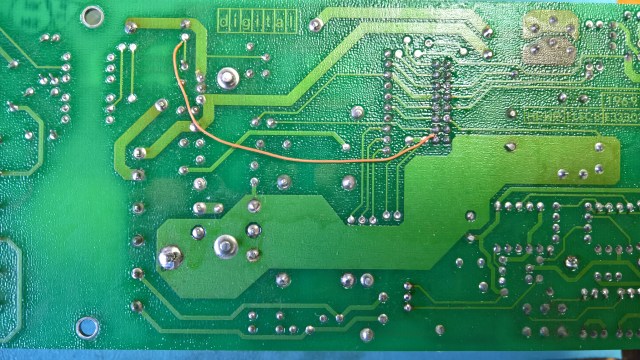
H7826 Repair of Corroded Track

Wire to replace a corroded track

This seemed to do the trick! I connected a load module from a MicroVAX 2000 and now the fans spin and there are voltages on the outputs. I checked the ripple on the 5V and 12V outputs and that was good. The LED does not seem to work, but the PSU powers up a hard disk and a PMAD-A card installed in the TURBOchannel Extender, so I think it is all working.

Now I need to find a cable to connect the TURBOchannel Extender to the DECstation 5000/240. I have found a 100-pin SCSI cable which fits but I don’t know if the pinout is correct so I dare not try it.

Posted in DECstation 5000/240, Retro-Computing | 3 Comments

Flocoder FLIP Now Processes Its Own Source

I am at the stage with my MUSS restoration that I can process the Flocoder FLIP source code with my own implementation of FLIP written in Flex and Bison.

My MUSL compiler can’t process all the Flocoder source files yet though, for a couple of reasons.

The first is that some of the source files appear to have too many END statements. I need to look into this to see if my understanding of the grammar is incorrect. However, these problems occur in files that I don’t think I need in order to re-create FLIP, so I will defer investigation. I may hit problems again when I try to build the MUSL compiler sources.

The second is that there are some elements of the syntax that are context-sensitive and can’t be parsed with Bison without some additional work. There are actually a couple of areas where this does not currently work. First, one of the Flocoder modules declares both a type and variable with the same name. The second is where addresses of procedures are declared, these create a syntax ambiguity which needs additional semantic processing. These problems are solvable, but I have not looked at them yet.

My next steps are to start generating C code from MUSL, but I think that to do it correctly I am going to have to resolve the context problems mentioned above.

Posted in MUSS, Retro-Computing | Leave a comment

Flocoder Flip Progress

I haven’t been doing much in the vintage computing arena recently, but I have finally got around to finishing off my crude implementation of Flip. The source code is up on GitHub.

My first attempt didn’t work very well. I was not ordering the boxes well and produced invalid MUSL because I used too many labels and GOTO statements. In the end I decided to reverse engineer the original Flocoder source for Flip. I created textual versions of some of the critical charts, you can see them in the source code (doc021 and doc031). The control structures represented by the charts didn’t look too easy to turn into normal structured code without GOTOs, so in the end I decided to take the easy path and code it with GOTOs just exactly as represented in the original Flip source charts.

My version of Flip can now take doc031 from the source code and produce the MUSL source from it. Furthermore, my initial MUSL parser is now able to parse the output from Flipping doc031, without any hand modifications to the Flip output.

The next step is going to be to try processing the other doc files and check that my parser can parse them all. After that I will try to get my MUSL parser to produce C code, so that I can generate a program that implements Flip from the Flocoder source.

Posted in MUSS, Retro-Computing | Leave a comment

MUSS Source Code Now Available

I have received qualified permission to publish the MUSS source code that was recently recovered, as free and open source software. It is available here.

I have also made a bit of progress on the MUSS restoration. My implementation of FLIP is improved but still not quite there yet. I also have a parser for MUSL, which parses the output of my FLIP implementation for one of the FLIP source modules, with a little hand modification before parsing it.

I have created a page on MUSS where I will report more about MUSS and its restoration.

Posted in MUSS, Retro-Computing | Leave a comment

Flocoder

I have now got a crude implementation of the Flocoder Flip program written using Flex and Bison. It can take a Flocoder file from the MUSS sources and extract what I hope is compilable MUSL code. The code is on GitHub.

I am not 100% sure that the code is valid as I have taken a very naïve approach to the code generation stage. Every BOX except the start box is labelled, and every BOX ends with a jump to the next box in the FLOW sequence. It does not attempt to merge consecutive BOXes.

However, I am hoping that this is enough to take the original Flocoder source for Flip and turn that into MUSL that I can then compile. The next step, which I have just started, is to create a MUSL to C compiler that will generate C from the Flocoder source for Flip, so I can get a version of Flip working in C. If I can do that then I should be able to process the Flocoder files using the proper code for Flip and compiling those to C as well.

Posted in MUSS, Retro-Computing | 4 Comments

MUSS GitHub Project

For anyone who wants to follow the effort to revive MUSS, I have started a project on GitHub. You can find the repository here. The initial effort is focussed on creating FLIP to translate the Flocoder to compilable MUSL and I have made a start on that.

Once I have FLIP then I will need to start the process of compiling MUSL. I will probably compile the MUSL to C and then compile the original MUSL compiler (written in MUSL), but that is a little bit further off.

Posted in MUSS, Retro-Computing | 1 Comment

MUSS Source Code


MUSS is the Manchester University Software System. It is an operating system that was designed and built at Manchester University for MU5, designed to be portable, and in fact ported to other machines.

In October 2017 I asked the editor of Resurrection, the Computer Conservation Society’s publication, to publish an appeal for information relating to MU5 to help my emulation project. Then, in December 2017 I received a response from Eur Ing Brian Tompsett a lecturer at Hull University. He had a full set of printed MUSS documentation and a 9-track magnetic tape which he thought may have the same documentation on it. The interesting thing about MUSS documentation is that it is really a combination of documentation and code, written using a system called Flocoder. This meant that there may be machine-readable source code on the magnetic tape. However,  Brian Tompsett thought that the tape may only contain the portable parts of the sources from the post MU5 era, covering MU6G, PDP11, VAX11 and MC68000. This also ties in with the printed documentation I have seen in a store room at Manchester, which all seems to be post MU5.

In April 2018 one of Brian Tompsett’s tapes was sent to The National Museum of Computing in Bletchley Park, where Delwyn Holroyd read the tape successfully a week ago. It contained a tar file, inside which were a large number of documentation and source code files.

The tape appears to contain the source code for Flocoder, the Manchester University system implementation language (MUSL) compiler, large parts of Version 11 of MUSS itself and other compilers, including Fortran and Cobol compilers that Brian Tompsett wrote. I am waiting for permission from Manchester University and then I hope to post the files, possibly on GitHub.

It looks like the best approach is going to be to hand build a processor to implement the Flocoder FLIP (Form LInear Program) function to extract the MUSL from the documentation, and then build a MUSL compiler, which will allow me to bootstrap the building of MUSS. It looks like it may be possible to get MUSS built for PDP-11 and VAX.

Posted in MUSS, Retro-Computing | 5 Comments

Another DEC Rainbow 100+

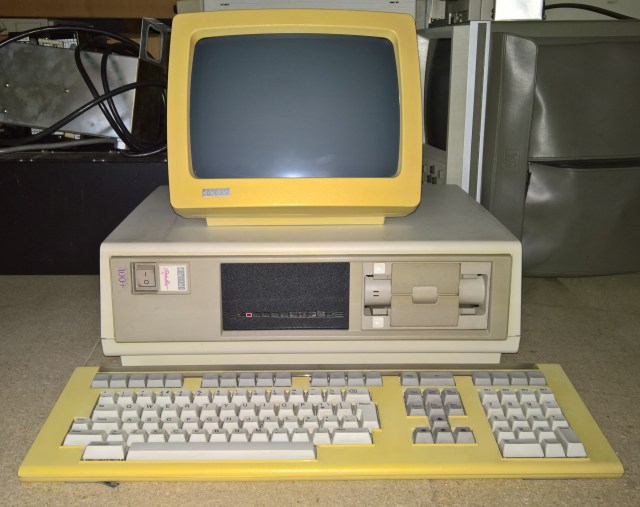
I recently acquired another Rainbow 100+. Here is a picture of it:

Rainbow 100+

The badges are on their side because this was installed in a vertical enclosure.

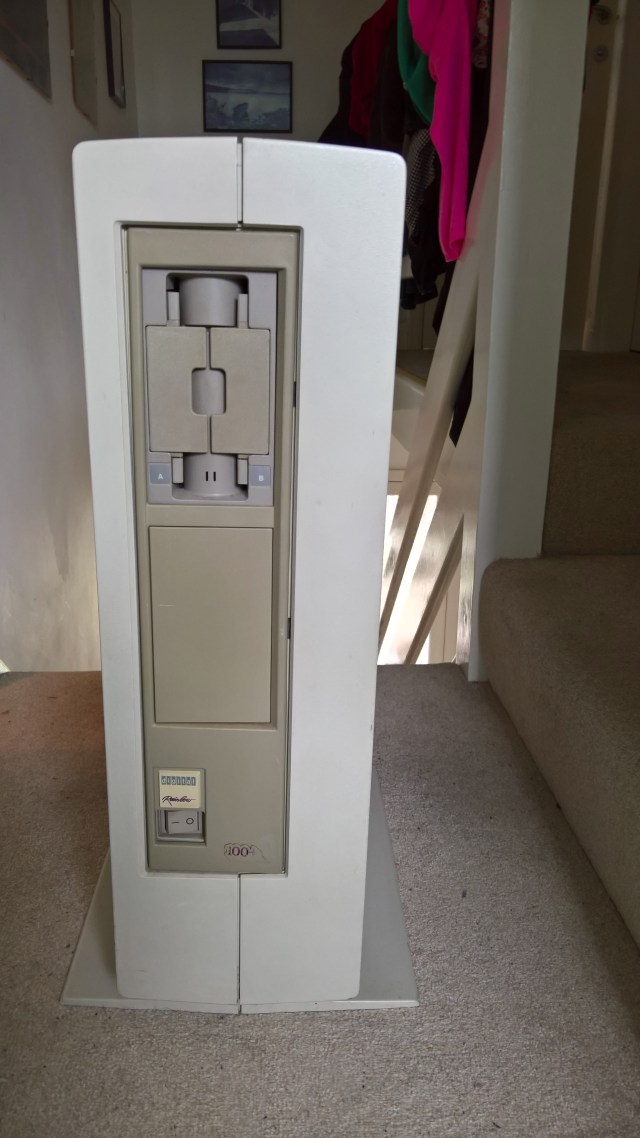
This came about because a little while ago I was given a Rainbow, and the person who gave it to me had a second one that he was going to keep. He told me that he wanted the vertical enclosure for his machine, like the one below, which happens to be one that I passed on to someone else some time ago:

Vertical Enclosure for a DEC Rainbow

When the opportunity arose to buy a Rainbow in a vertical enclosure I let him know. He wanted the enclosure but not the machine inside. So we agreed that I would contribute to the cost of the purchase, take the Rainbow itself and he could keep the enclosure.

When I got it home it was in a pretty clean condition. It contains an RD51 hard disk, an RX50 floppy disk drive and a 192K memory expansion options, for a total of 320K memory. The VR201 is an amber version.

Before powering it on I visually checked the PSU, it looked fine. I then imaged the hard disk, just like I did with the previous Rainbow. Interestingly, the first attempt to read the disk failed completely. The disk span up quite happily, but the MFM emulator could not find any data. Cycling power seemed to fix it and I imaged it twice just to be sure.

I then installed the hard disk emulator in place of the hard disk and powered it up. Booting from the emulated hard disk brought up MS-DOS 2.11. The AUTOEXEC.BAT then took me into the Rainbow Serial Port Setup Utility (SETPORT) program. I found that the hard disk had WordStar 3.31 installed. At some point I will go back to that and remind myself what WordStar was like.

Anyway, I now have another Rainbow and another VR201 monitor, which is good in case I need some spares.

Posted in Retro-Computing | 5 Comments

More Leaking Batteries

I haven’t been very active lately because I have had to temporarily relocate my collection. While moving it back again I took the opportunity to reorganise things a bit. In doing so I came across the first two PC motherboards I ever bought. I found that both had leaking batteries. I have another machine, a DECstation 220 that has suffered as a result of the same kind of battery leaking, so I decided to remove these batteries immediately.

The very first motherboard I ever bought was a 286 board, with a Headland HT-12 chipset. If I remember correctly it had 1MB of memory.

The second board I ever bought was a 386SX board with an ALI chipset.

I have added these boards to the pile of things to get working. I am a bit behind at the moment with the fact, as mentioned above, of having to temporarily relocate the collection. I am still working on the TURBOchannel Extender PSU, a couple of ZX Spectrums and the DECstation 220. However, when I get a moment I will give these two boards a very quick spin just to see if they still work at all.

Posted in Retro-Computing | Leave a comment

Update on H7826 Power Supply Repair

It has been a while since I last posted anything about what I have been up to. However, I have been busy trying to find out what is wrong with the H7826 power supply out of my TURBOchannel Extender.

I received advice that there were errors in my method for checking activity on the primary side and that the fault could be on the primary side. I spent some time reverse engineering the schematics for the primary side. Not being an electronics engineer I may not have drawn this logically, and there will be tracing errors. I will update the images as time goes on, so by the time you read this it may have been improved, but don’t count on it. Unfortunately the part numbers are not labelled on the boards, so I have labelled photographs with part numbers that I have made up myself.

This is the schematic for the main input section.

This is the schematic for the 50-19530 daughter board, which I think is for Power Factor Correction.

This is the schematic for the 5019572 daughter board, which controls the switching transistors. This one was done by Matt Burke, I have added labels to a photo and filled in a couple of missing bits.

Further probing with an oscilloscope revealed that the 555 on the 5019572 daughter board was not oscillating, which means the switching transistors are not being switched. I then found that the Vcc input to the 555 was not rising above about 0.2V. So the next thing was to see why this might be.

Unfortunately, while doing the probing around the 555 I think I managed to discharge the large smoothing capacitors near the 555. Thankfully I had already turned the power off, but there was a sharp crack from the spark. I could not find any physical damage anywhere.

I took the 5019572 out to test it on the bench with a bench power supply. I found that it drew far too much current, the current limiter on the bench power supply happened to be set to 1.2A, and that is what it drew. Clearly there was a short. I suspected the 555, partly because of the spark problem. When I took it out I found that it was indeed shorted across Vcc and Ground.

I replaced the 555 and then I found that its output oscillated. However the current draw was still high and the other IC, the UC3842 got very hot. I checked all the resistors, diodes and capacitors for shorts and they all appeared to be fine, so I suspect the UC3842 is also bad.

I now have to order a replacement UC3842 and see if I can get the daughter board to work correctly.

I am not sure if the short (or shorts) have been caused by the spark I provoked. However, the fact that Vcc on the 555 wouldn’t go above 0.2V when the board was installed suggests it may have already been shorted, or the UC3842 was already bad, but of course I won’t know until I have the daughter board working again and installed back on the main board.

Posted in DECstation 5000/240, Retro-Computing | 2 Comments